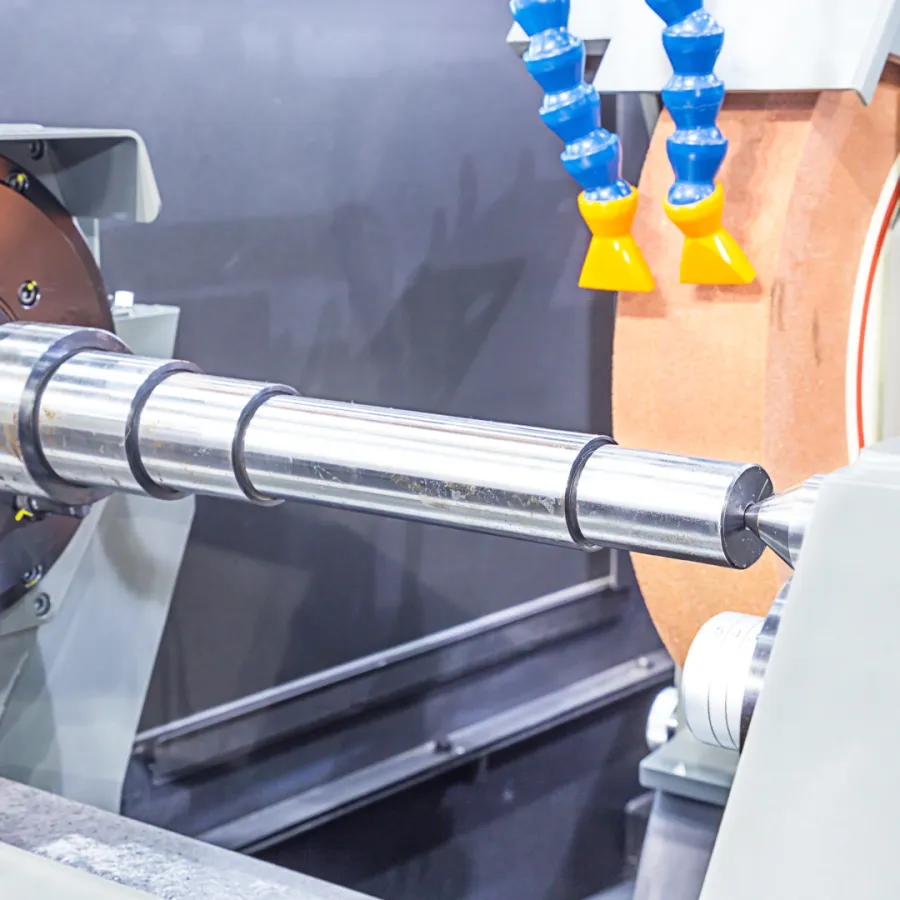
Grinding wheel selection
Ranked by fit,
not brand.
Answer five questions about the job. Get up to five ranked wheels from makers' published selection rules, each with the reason it was chosen.
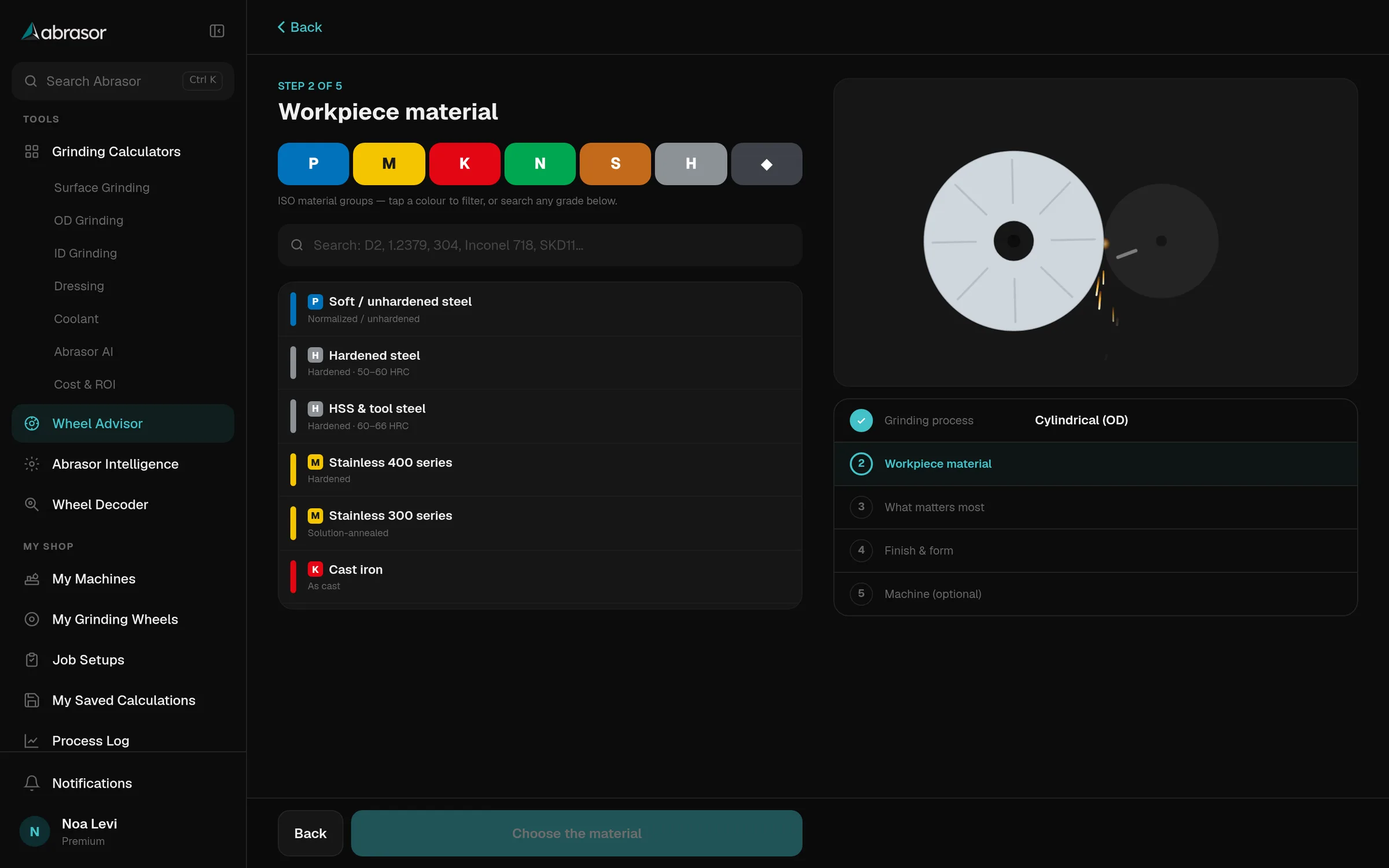
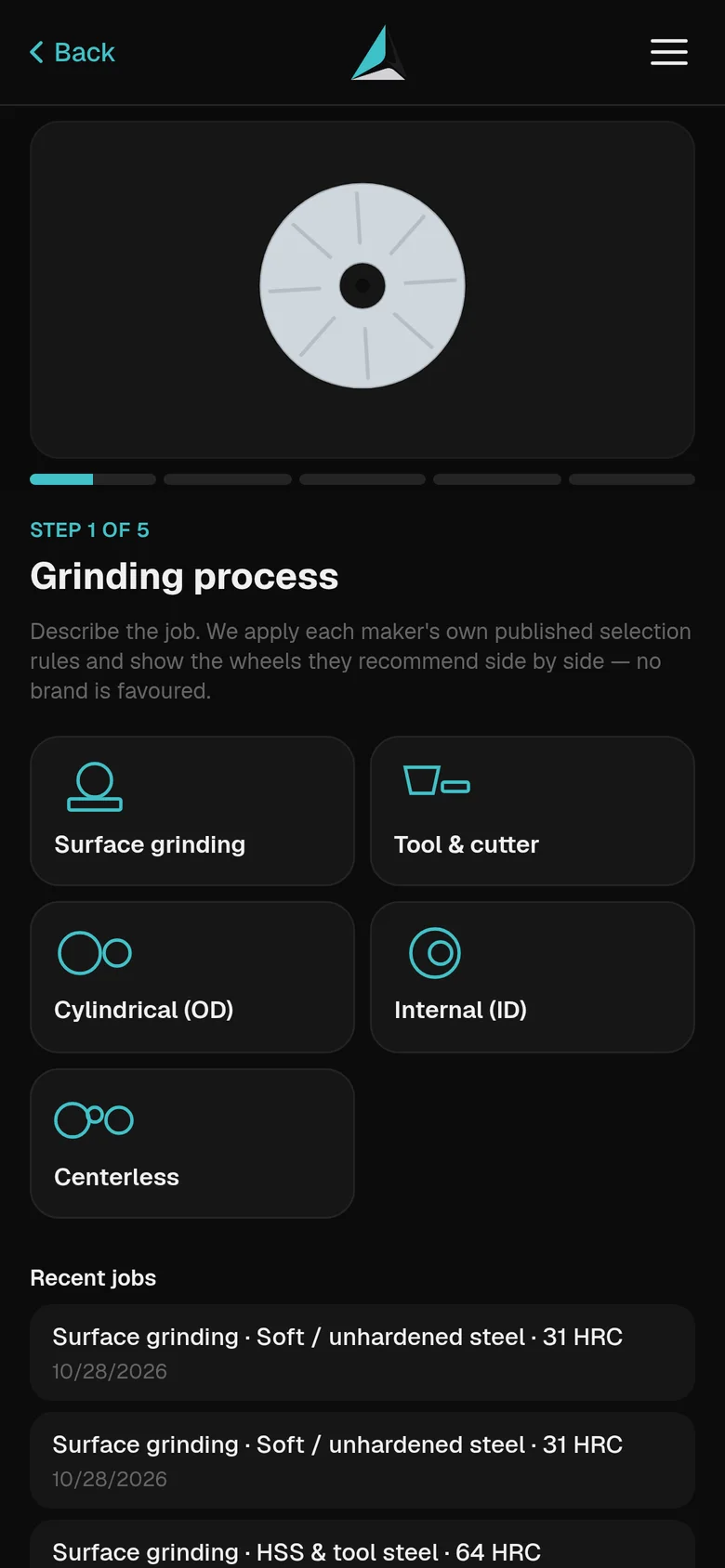
Five questions. One live drawing.
Describe the job the way you would at the machine. A drawing of the wheel and the work follows every answer.
- Grinding processSurface, tool and cutter, cylindrical OD, internal ID or centerless.
- Workpiece materialISO groups P, M, K, N, S and H, or search a grade such as D2, 1.2379, 304 or Inconel 718. Add the hardness in HRC.
- What matters mostFor example maximum productivity, high productivity or standard.
- Finish and formWhat the surface and the profile have to hold.
- Machine optionalPick one from My machines and its limits come with it.
Cylindrical OD: the wheel meets the outside of a turning part.Surface grinding: the wheel runs over a flat part as the table moves.Tool and cutter: a cup wheel works the edge of a tool.Internal ID: a small wheel grinds inside the bore.Centerless: the part rides on a blade between the grinding and regulating wheels.
Every option explains itself.
Up to five ranked options, the best three first. Each shows the wheel, why it was chosen and where the rule came from.
- Abrasive
- White aluminium oxide
- Bond
- Vitrified
A diagram with a generic ISO 525 example, not a result from the app.
No favourite maker, no paid places. The job picks the wheel.
What sets the order
- Process, material and hardness
- What matters most to you
- The finish and form you need
- Your machine's limits
What never does
- Who made the wheel
- Money from a wheel maker
- Sponsored cardsThey carry a label and sit outside the ranking.
Rules come from makers' published selection guides and catalogues. Designations are never invented, and unverified ones are marked.
Tell it how the run went.
Report the outcome after a run. The next recommendation for that kind of job adjusts.
- Repeat a recent jobRecent jobs wait on the first step, ready to run again.
- Works offlineThe rules are cached on the device, so the advisor answers without signal.
How did the run go?
- Worked well
- Burn
- Loaded or glazed
- Chatter
- Finish not good
- Lost form
- Lost corners
- Wore too fast
Next time: the recommendation for this kind of job takes the outcome into account.
Wheel Decoder
Read the marking on the wheel.
Type it, or scan it with the camera. The decoder reads ISO 525 and 13 makers' own formats. Free, with no AI credits.
- What each part meansAbrasive, grit, grade, structure and bond, in words.
- Plain ISO, plus comparable wheelsThe neutral specification and comparable wheels from other makers.
- Into your libraryAdd a decoded wheel to My grinding wheels.
Wheel marking decoder
Type the ISO 525 code printed on the wheel. The app also reads 13 makers' own formats.
The ISO spec is free. Designations are Premium.
Free shows the neutral ISO specification. Premium also shows maker designations, with equivalents labelled as the same grain family, not the same product.
Free
$0- The neutral ISO specification for each option
- The Wheel Decoder
- 3 AI queries a month
Premium
$4.99 a month, or $49.90 a year- Maker designations next to the ISO specification
- Grinding wheel library and saved calculations
- 50 AI queries a month
Grinding wheel questions.
Short answers to what people ask most about choosing and reading wheels.
How do you read a grinding wheel marking?
An ISO 525 marking such as WA60K8V reads left to right: abrasive (WA, white aluminium oxide), grit size (60, medium), grade (K, the bond strength from A soft to Z hard), structure (8, the grain spacing, higher is more open) and bond (V, vitrified). Numbers or letters before or after it are the maker's own codes.
How do I choose the right grinding wheel?
Start from the workpiece material and its hardness, the grinding process, and what matters most: removal rate, finish or wheel life. Then check the contact area, the finish you need and your machine's speed limit. The Wheel Advisor asks those five questions and ranks options from makers' published selection rules.
Should I use a soft or hard wheel for hardened steel?
Usually softer. On hard materials the grains dull quickly, and a softer grade lets them break away and expose sharp new edges instead of rubbing and burning. Soft, ductile materials generally take a harder grade.
What grit size gives a better surface finish?
A finer grit, meaning a higher number, gives a lower Ra, while a coarser grit removes stock faster. Dressing, wheel speed and spark-out change the finish too, so grit is one setting among several.
Are the recommendations sponsored by wheel makers?
No. Options are ranked by technical fit from makers' published selection guides and catalogues. Sponsored cards, when shown, are labelled and sit outside the ranking.